storm

Recently my family was enjoying the beach on an overcast day. In the distance we could see a storm drifting in. As the storm approached the wind began swirling. The dark clouds became darker, moving towards the light horizon until you could see the merger point, where the black clouds touched the calm skies. The contrast was clear. Its energy filled the air, moving all around us. We were compelled to stay and witness this merging conflict. Its electricity sparked the kids, as they ran and laughed and did cartwheels on the beach as the storm moved closer. The calm converging the darkness moved us all. We drank it in until the ensuing lighting and pelting rain forced us from the beach.

photo (6)

That moment of collision, where the calm meets the storm, so striking, so powerful, altering our world, is terrifying and thrilling at the same time.   Stark is the point where calm and conflict  meet..

These moments of collision happen too often in those of us who care for someone with Alzheimer’s. We have calm in our day, in our normal routine that is the stability of someone in this condition. Then something moves in to upset the routine….this week for my mom, a UTI, something minor, that presents itself in weakness and fogged memory. Yet the conflict that arises in me as I change my routine, take her to the doctor, get her medicine, take her for her follow up, answer her questions, worry about her weakness, imagine it may be something bigger…all these things swirling around in my head drain me and scare me at the same time.

I try to do something with all this stuff inside, so I paint. I paint the storm. At first, I lay out the storm with smooth brushstrokes and defined lines, but it does not truly depict the image. Instead, I hold the brush at the end and move in large strokes across the canvas. My peers in the art room look over my shoulder. I like the energy, they say. I can feel it. So I continue in this mode, in large, jagged movements over the canvas. At one point I begin to doubt, and start stroking, blending in the colors, with softer strokes, smoothing in the foreground. What happened, says my teacher. You’ve lost the movement. Don’t work it so much she says.

Again, art reflects the conflict inside me. The times I see a situation brewing and try to manipulate it, smooth it over, instead of letting it be. I try to control it, or minimize it, or worse yet, let it torment me inside while externally I smooth it over, hiding the conflict of emotions inside. The conflict of worry, of guilt of being angry, of weariness of this situation, of wanting to be free of all this. So I continue to work on this painting, and myself. I’ve changed the composition a bit, but I have not changed the storm clouds. My teacher says her eye is drawn to the midpoint of the painting, where the white clouds meet dark clouds. She thinks that to be the strongest part of the painting.

photo (8)

Last week I spoke at a caregivers conference, reading one of the poems I had written about caring for my mom. At different times during the conference, three women approached me, telling me they felt the same feelings I am feeling, feelings of conflict, feelings of despair. I held their hands, gave them a hug.  I know there are many of us caught in this storm of caregiving, of conflicting feelings of sorrow, anger, guilt, weariness as we continue to care for our loved ones day by day by day by day.

Storms move in and out of our lives. But in the moment before, and then right after, there is stillness. A moment of peace. In that moment of stillness, even as a storm approaches, we as caregivers must take rest. A breath. A prayer. An exhale. That is where we find the strength to weather what is ahead.

discovery

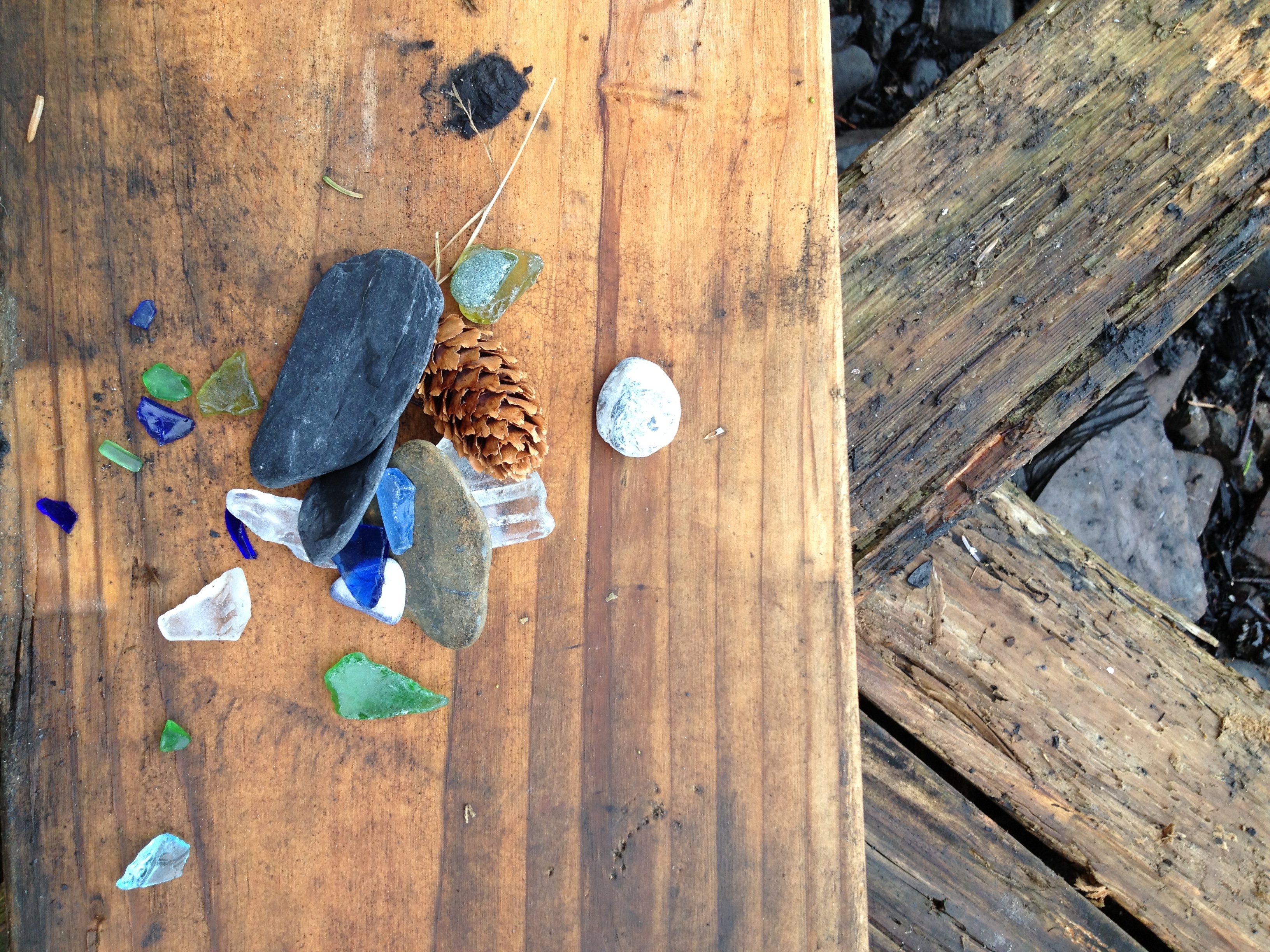
photo-1I scour the rocky beach with my young friend Micah. Through his eyes I’m discovering all the wonders of this remote bay in Kodiak. A simple request to see the bay has evolved into a scavenger hunt along cliffs and boulders. As I scamper over barnacled rocks in my slippers, I’m transported into Micah’s playground of tide pools, tiny hermit crabs, even a sea urchin. Jagged rocks loom large like sentinels over these beach treasures. But the treasure that most catches my eye glints slightly beneath the puzzle of smooth , black, flat beach rocks perfect for skipping in the ocean.

boots

“What is that?” I ask Micah as he chooses the perfect stone to throw into the water. He stoops down to look at the tiny blue treasure. “Sea glass” He picks it out, cups it in his hand and hands it to me.

“Blue is the best color. That’s the most rare on this beach. That’s my favorite. “I examine the tiny sapphire jewel in my hand. The color is deep. The edges round and smooth.

“That’s a good piece. I know a perfect place where we can go and find some more. Come on!”

photo-2

Over kelp bulbs, seaweed, rocks we scramble until Micah and ruddy cheeked 5year- old Stuey lead me to the promised land. “Look at this one,” says Stuey . In his chubby little palm lays a perfect piece of aqua sea glass.

“Oh, that’s beautiful. Can I have that piece?” I ask.

His little blond head ponders for a moment. He shakes it back and forth.

“No,” he says. “I like this piece.” He scrambles off to find some more.

A little miffed I crouch down to seek out my own. I discover a large blue piece to examine. I love the color. “What about this one?” I offer.

Micah comes over to inspect. “No,” he says, “the edges are too jagged. It’s not ready yet.”

Stuey returns, clenched fist uncurling to reveal a large brown piece.”I like this one.” Micah examines. ” No Stuey. Not that one. It’s too sharp. You’ll cut yourself.”

“No I won’t,” he protests, clutching the jagged piece in the flesh of his palm even harder. “Look. I’m not hurt!”

And as I watch that cherub faced boy tight fisted clench that shard I realize

I am that broken piece,

Shattered from the impact of watching my mother decline.

Like sea glass worn away over time

Broken pieces of the woman she once was

Her memory, cognition, awareness are diminished

By this disease called Alzheimer’s.

The brain eroded by plaques,

Minerals eating away her mind

As sea salt eats away glass

Rendering it transparent

Frosted, cloudy.

While I still broken, fragmented, attempting to to grasp understanding of this disease,

Its process like salt burns my wounded heart,

I still have sharp edges, cutting words, distorted from lack of sleep, anxiety of the unknown,

Guilt divided between duty to my children and husband and duty to her.

I too held on too tightly

Squeezing the broken pieces of my life too hard

Thinking it was noble, beautiful to hold on to the pain and let uncertainty and fear and guilt grip me

as I watch this disease wear down my mother.

Yet she like sea glass

Continues to shine

Luminous beauty beneath lost memories,

Spirit glowing under frosted edges,

Edges smooth and gentle

A treasure to be found.

sea glass


My friend told me the story of sea glass:That true sea glass has rounded edges

And pieces like bottle tops and bottoms are most rare

As are the colors blue and aqua.

And in a piece of true sea glass

The original color remains the same

Only gilded by the coat from the sea.

A myth about sea glass Is to return the broken pieces not yet polished

Back to the sea as you make a wish.

So I will throw this broken fragment back to the sea

And not wish for a cure

Or a miracle or her memory back.

Instead I will find treasure in her gently worn life

Her smoothed edges

Her luminous spirit

And clutch it to my heart.